
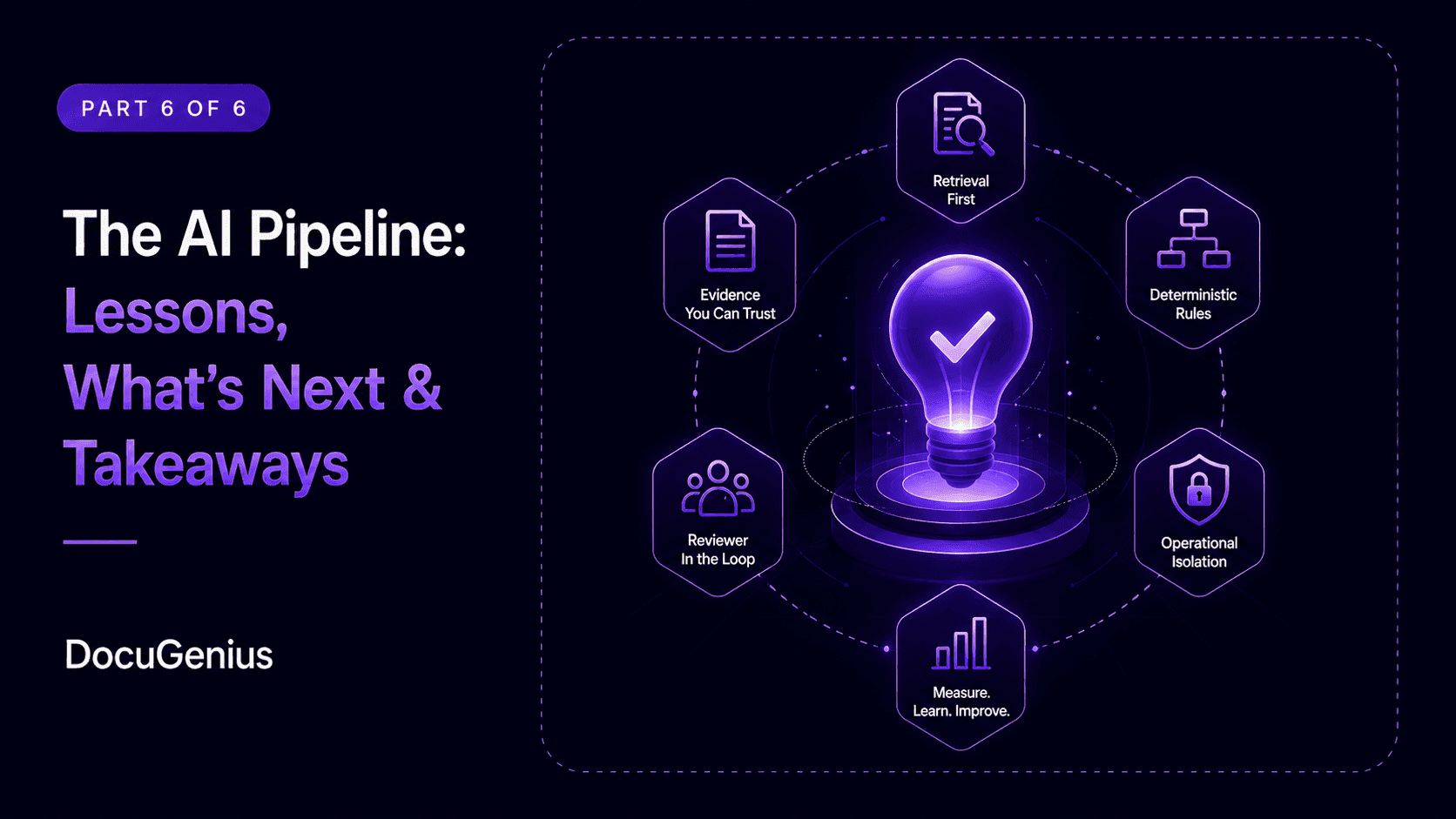
Part 6 of a 6-part series on building DocuGenius, an AI-powered document compliance engine for document workflow automation across regulated industries.
| Part | Topic |
|---|---|
| Part 1 | Series Overview: What We Built and Why It Matters |
| Part 2 | The Problem & Architecture |
| Part 3 | The AI Pipeline: Ingestion, RAG & Multi-Agent Extraction |
| Part 4 | Evaluation, Evidence Highlighting & the DMN Rule Engine |
| Part 5 | Cost Optimization, Dashboard & Production Results |
| Part 6 (this post) | Lessons Learned, What's Next & Final Takeaways |
← Back to Part 5: Cost Optimization, Dashboard & Production Results
TL;DR: The biggest lesson from building DocuGenius is that AI document compliance is not an LLM extraction problem. It is a systems problem: retrieval quality, deterministic rule evaluation, evidence traceability, cost control, operational isolation, and a workflow that reviewers can actually trust. This post is for teams scoping, buying, or building the same kind of platform.
What does it really take to build AI document compliance that works?
It takes more than a strong model. It takes retrieval that reliably finds the right evidence, a decision made outside the model, evidence stored alongside every verdict, operational isolation, cost controls, and a workflow that helps reviewers move faster without forcing them to trust an opaque answer. The model is one component. The system around it is the product.
Lessons Learned
The retrieval layer is worth getting right early. How the system finds the right evidence for each criterion mattered more to overall quality than any single model choice.
A structured, multi-step workflow is powerful but harder to operate than a single prompt. Visibility into why a given criterion passed or failed turned out to be essential, and worth investing in early, not late.
Business-editable rules were one of the highest-leverage product decisions. Letting compliance teams change rules without code turned rule changes from a software-delivery problem into a configuration workflow.
Tying every verdict back to its source is harder than it looks. Real documents are messy, and getting that link right is what makes the output something a reviewer will actually trust.
Operational isolation was worth the overhead. In a multi-tenant workflow, one customer's burst should not degrade another's. It adds complexity, but it makes the platform predictable under real spikes.
What We Would Build Earlier If We Started Over
If we were rebuilding from scratch, we'd invest in evaluation tooling on day one. Manual review helped us validate the platform, but structured evaluation made iteration dramatically faster once we had it.
The reason is subtle: in document compliance, a top-level "pass" can hide a weak answer underneath: the right final verdict reached for the wrong reason. Auditable review means measuring the quality of the evidence, not just the final outcome.
What's Next on the Roadmap
We're expanding the platform around three themes: broader document-review use cases, easier movement of reviewed results into downstream systems, and stronger handling of imperfect or scanned documents.
On the platform side, we are continuing to improve evaluation, cost controls, and deployment flexibility so different customers can run the workflow at different scales without changing the core review experience.
We are also building a connector to Salesforce, so reviewed results flow directly into the records your teams already work in instead of living only inside the platform.
The broader bet is that compliance checking is a horizontal capability. The same product pattern that supports one regulated document workflow can support loan applications, food safety audits, logistics files, insurance claims, and other evidence-heavy reviews. Business-editable rules make that practical. Structured extraction makes it accurate. Asynchronous processing makes it scalable.
Final Takeaways For Teams Building Compliance Automation
If you're building or evaluating AI compliance review software, don't start with the model. Start with the guarantees the workflow needs.
The practical requirements are:
- Traceability: every verdict needs evidence and source references
- Determinism: business rules should be evaluated outside the LLM
- Configurability: compliance teams need to change rules without code changes
- Operational isolation: one tenant's workload should not degrade another tenant's processing
- Cost visibility: AI usage, repeated-work avoidance, document complexity, and rule-set complexity need to be measurable line items
- Human review: the interface should make reviewers faster, not force them to trust an opaque answer
The winning pattern for us was not "LLM reads document and decides." It was a workflow built around verifiable evidence and a decision a reviewer can defend. The model assists, but it is never the final authority.
That pattern is what makes an AI-powered document compliance engine credible for real regulatory workflows, whether the use case is healthcare eligibility, insurance claims review, loan document review, food safety compliance, logistics compliance, or enterprise document intelligence.
Frequently asked questions
What is the single biggest mistake teams make when building AI document compliance?
Letting the LLM make the final compliance decision. LLMs are useful for extracting evidence from a passage, but the final decision layer needs to be deterministic and live outside the model. Otherwise the platform is difficult to audit, reproduce, and defend.
What matters most when retrieving evidence for compliance?
Not missing the evidence that matters. Failing to surface a passage that contains the relevant evidence is far more costly than reviewing a little extra context, so the system is designed to err toward finding everything relevant.
What's the most underrated piece of AI compliance infrastructure?
Evaluation. Without a disciplined way to measure whether a change made the system better or worse, at the level of individual evidence, not just the final verdict, you're guessing.
Acknowledgement
This work was shaped by the engineering effort behind DocuGenius, built by the team at ITQuarks, whose product thinking, implementation, and delivery discipline were instrumental in bringing the platform to life.
Suggested CTA
If your team is scoping, buying, or building an AI document compliance platform for claims, eligibility, lending, supplier review, or regulatory work, we'd be glad to compare notes against your real workflow. Talk to the DocuGenius team.
