
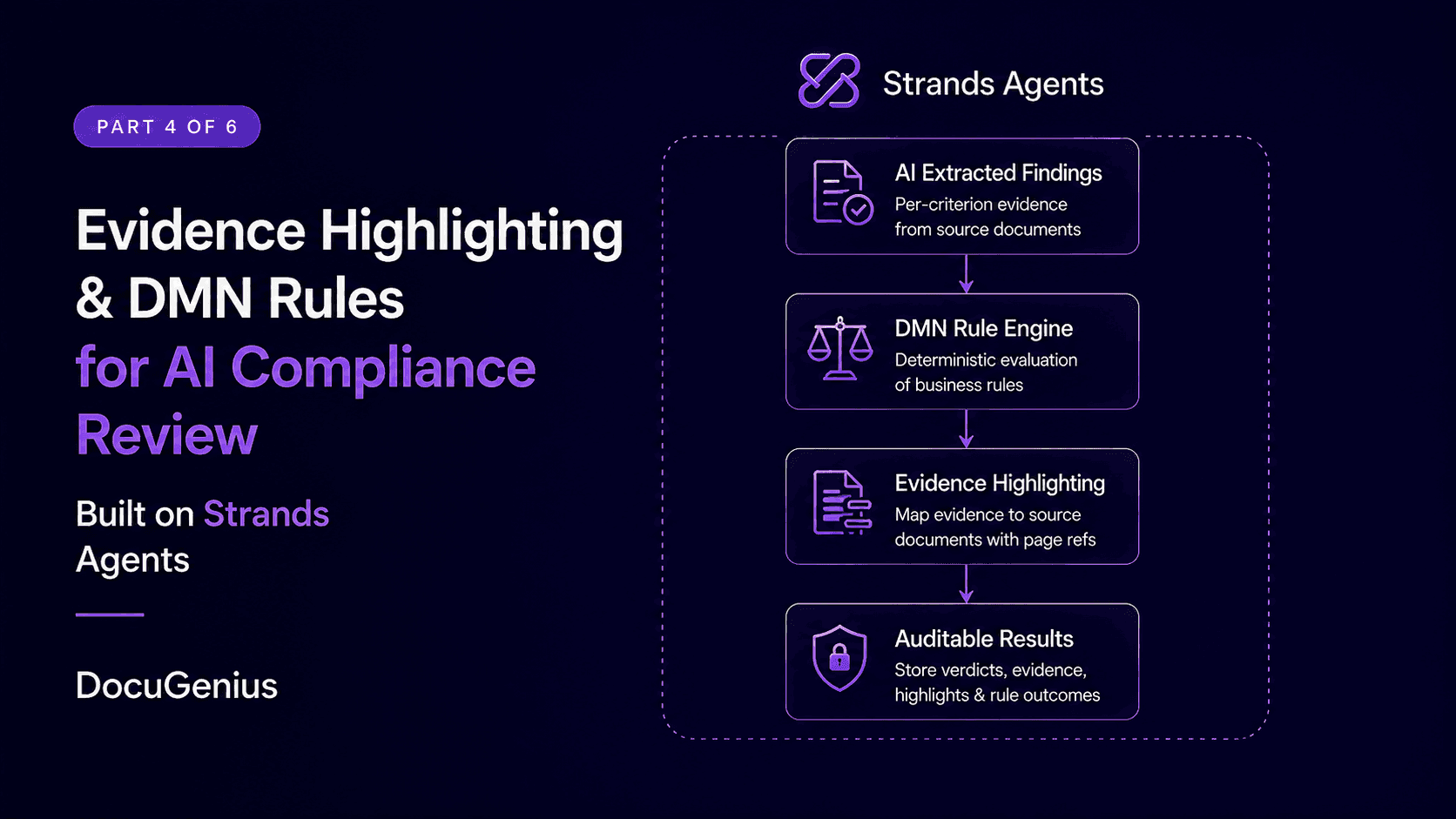
Part 4 of a 6-part series on building DocuGenius, an AI-powered document compliance engine for document workflow automation across regulated industries
| Part | Topic |
|---|---|
| Part 1 | Series Overview: What We Built and Why It Matters |
| Part 2 | The Problem & Architecture |
| Part 3 | The AI Pipeline: Ingestion, RAG & Multi-Agent Extraction |
| Part 4 (this post) | Evaluation, Evidence Highlighting & the DMN Rule Engine |
| Part 5 | Cost Optimization, Dashboard & Production Results |
| Part 6 | Lessons Learned, What's Next & Final Takeaways |
← Back to Part 3: The AI Pipeline
TL;DR: Raw LLM verdicts are not a compliance decision. DocuGenius adds three layers on top of the AI pipeline: deterministic rule evaluation, source-document evidence review, and business-editable rule management. The goal is not just to answer faster. It is to produce decisions that reviewers can audit, defend, and reproduce. This post is for operations, compliance, claims, and underwriting leaders, not just engineers.
What turns an LLM answer into a compliance decision?
A compliance decision is more than an LLM verdict. It is a deterministic outcome computed from a set of per-criterion answers, each backed by extracted evidence and a page reference. The LLM decides whether a fact exists in the document. A separate rule layer decides what that fact means for compliance, and produces an output a reviewer can audit, defend, and reproduce.
Deterministic Evaluation: Where the Final Verdict Is Decided
Compliance criteria are rarely a flat checklist. A top-level eligibility or compliance requirement usually depends on several supporting conditions, sometimes with exceptions or alternative paths.
After the extraction layer returns per-criterion findings, the system applies business rules outside the model. The LLM decides whether individual evidence exists. The rule layer decides what that evidence means for compliance.
That separation is the point. LLMs are reliable at reading a passage and judging whether supporting evidence is present. They are less reliable when asked to combine many business conditions into a final outcome inside a single prompt. Keeping the decision deterministic means the final verdict is explainable and reproducible, regardless of what the model returned for any single item.
That distinction is what makes AI compliance automation and regulatory document review defensible at audit time. The LLM extracts evidence. The rule layer makes the decision.
Evidence Highlighting on the Source PDF
A reviewer should be able to open the original document and see exactly where each verdict came from.
For every piece of extracted evidence, DocuGenius maps the model's supporting text back to the source document so reviewers can inspect the surrounding context. That sounds straightforward, but real PDFs are messy: text extraction can be inconsistent, tables break reading order, and models may lightly paraphrase the supporting passage.
The platform uses a controlled evidence-alignment layer rather than asking the model to make the final visual annotation decision by itself. The important product outcome is simple: a reviewer should be able to jump from a verdict to the source material quickly, without hunting through the document manually.
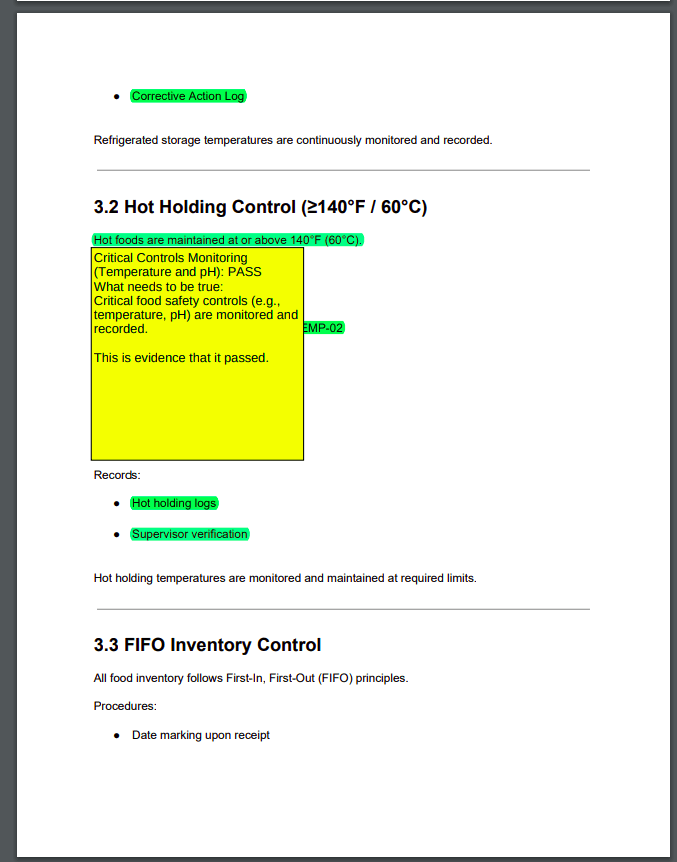
Figure 1: A PDF sample with color-coded markers tied to specific compliance criteria.
In practice, this is one of the trickiest pieces of the system to get right, and we keep it deliberately inspectable, so reviewers can trust the link between a verdict and its source instead of taking it on faith.
The No-Code Rule Engine: DMN
One of the highest-leverage product decisions on the platform was making rule sets editable by the business, not by engineering. Compliance analysts author rules in a visual editor and upload them as DMN files; the platform turns each rule set into a structured evaluation workflow automatically.
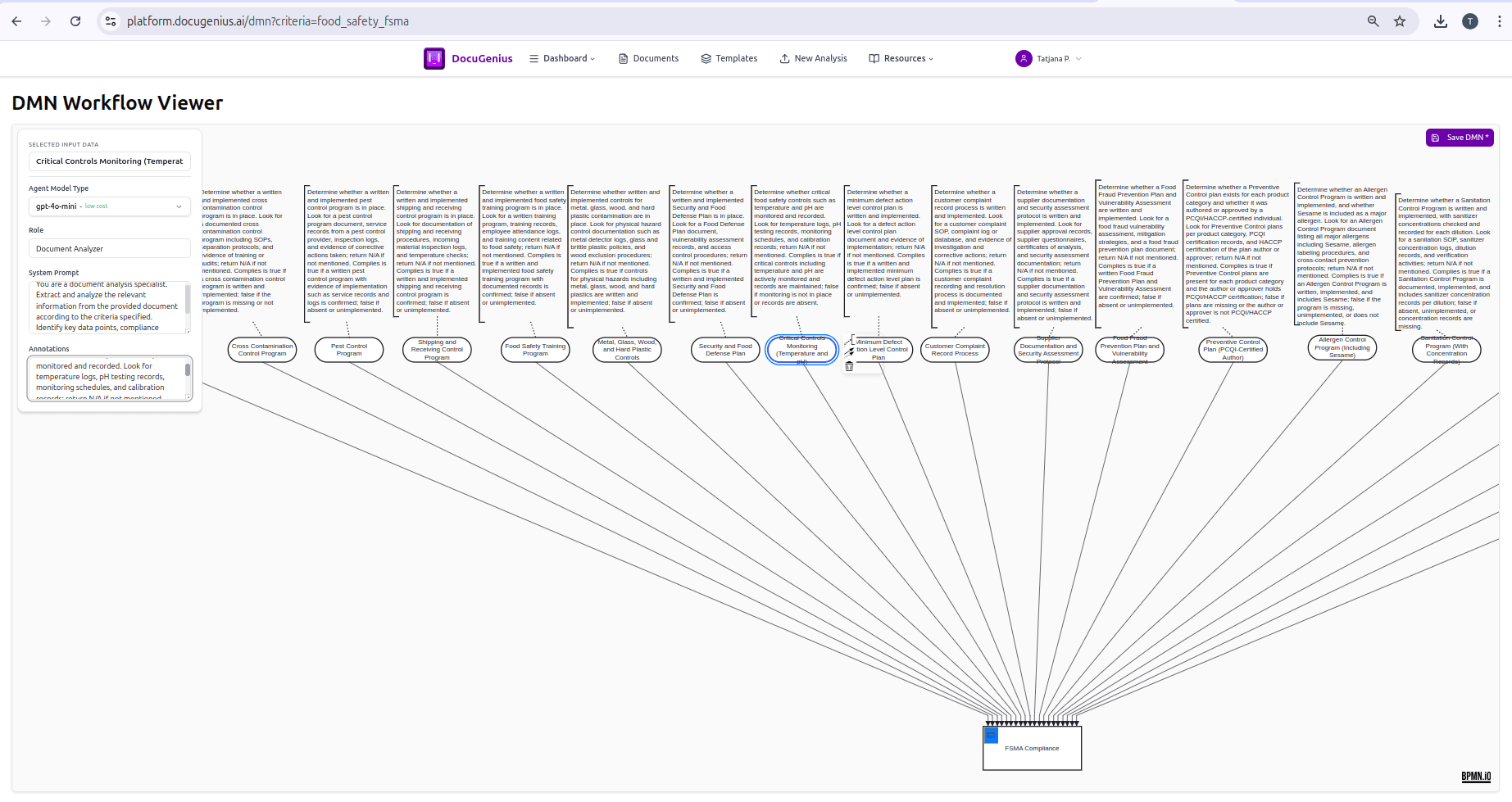
Figure 2: Business users author rule sets in a visual editor; the platform turns them into structured evaluation workflows automatically.
No deployment, no code change, no engineering ticket. A compliance analyst can define a new review process and begin testing it without waiting for a product sprint.
That decoupling is what makes the platform horizontal. The time from "we need to support this new compliance domain" to "it is live in production" drops from weeks to hours.
Auditable Results: Why Storage Design Matters
The output layer is where security and compliance become visible to the business.
DocuGenius does not treat the final answer as a disposable chat response. It stores structured verdicts, extracted evidence, page references, the highlighted PDF, and full rule-evaluation results in controlled, access-scoped storage. Authorized users can re-open any decision and see how it was reached.
That design choice matters for privacy. Sensitive data should be stored intentionally, governed by access controls, retention rules, and tenant separation, and kept out of operational logs. Logs are useful for debugging and monitoring. They are not the right home for PHI, PII, financial records, or claim documents. The compliance report and its structured database records are the system of record. Logs stay operational metadata.
The benefit translates directly across verticals:
- Healthcare: HIPAA-aligned reviews keep patient evidence tied to a specific criterion and report, rather than scattered across manual notes or chat threads.
- Insurance: every claim has an auditable trail from document to evidence to coverage decision.
- Financial services: defensible review of loan and identity documents, with the evidence attached.
- Food safety, construction, logistics, public sector: standardized review of supplier certificates, safety records, driver qualification files, and grant documentation.
The outcome is not just a faster review. It is a safer review: fewer manual copies of sensitive files, fewer uncontrolled spreadsheets, fewer ambiguous decisions, and a clearer audit trail for every compliance outcome.
Frequently asked questions
Can business teams change compliance rules without engineering involvement?
Yes. Rules are authored in a business-editable format and uploaded to the platform. DocuGenius turns them into a structured evaluation workflow automatically. Engineering is not in the loop for routine rule-set changes.
How does evidence highlighting handle imperfect AI output?
The system uses an explicit evidence-alignment layer that maps extracted support back to the source document. The goal is to tolerate normal PDF and model imperfections while still giving reviewers a clear source reference they can inspect.
Acknowledgement
This work was shaped by the engineering effort behind DocuGenius, built by the team at ITQuarks, whose product thinking, implementation, and delivery discipline were instrumental in bringing the platform to life.
Suggested CTA
If you're evaluating an AI document compliance platform and want to see how evidence highlighting and DMN-based rules hold up against your actual files and rule sets, we're happy to walk through it with you. Talk to the DocuGenius team.
What's Next
In Part 5, we cover how the platform stays affordable at scale, how the dashboard supports compliance teams, and what production-readiness looks like for real document workflows.
Read Part 5: Cost Optimization, Dashboard & Production Results, now live. We're also sharing the series one part at a time on LinkedIn, so follow DocuGenius there or bookmark the blog.
