
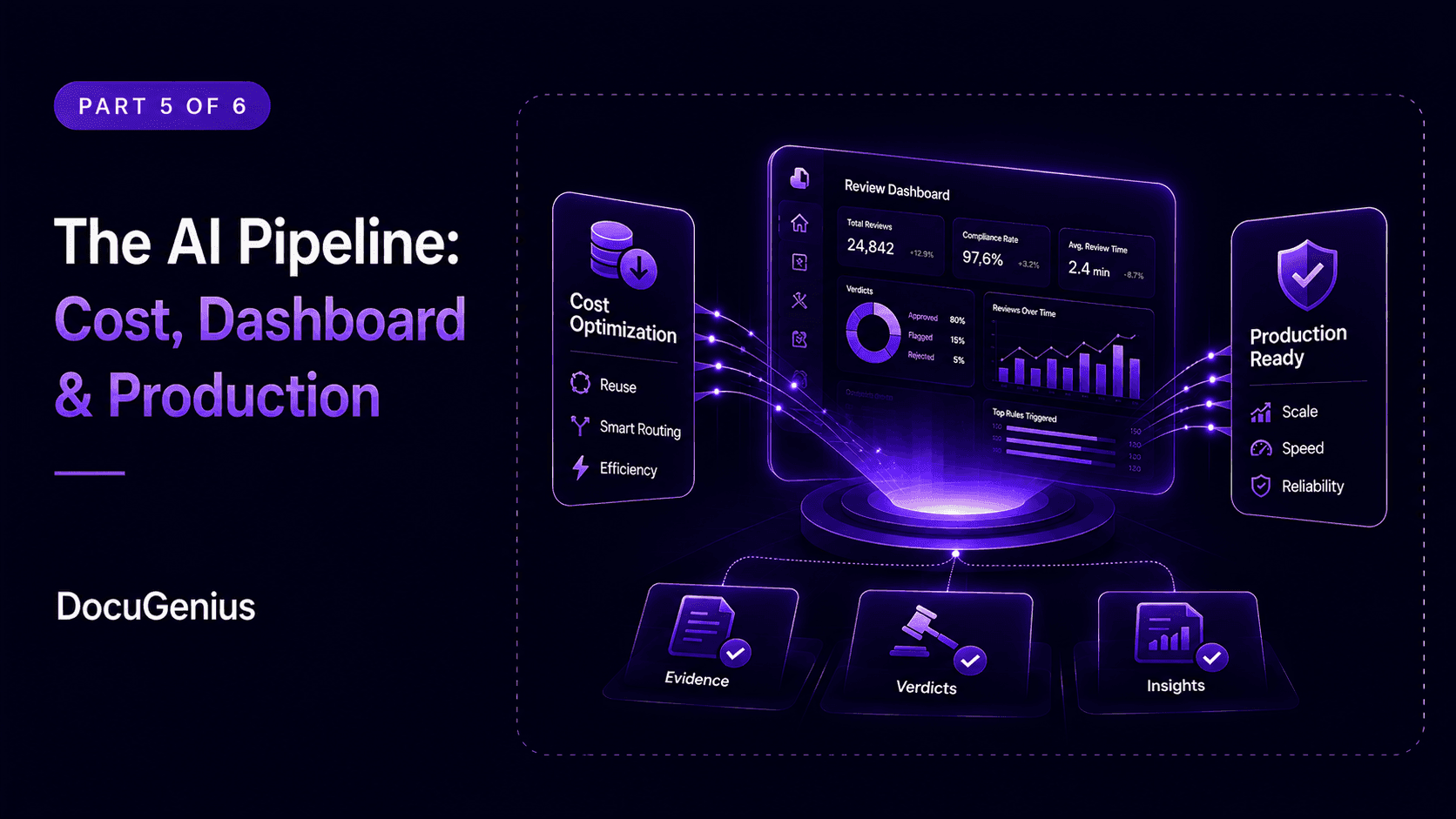
Part 5 of a 6-part series on building DocuGenius, an AI-powered document compliance engine for document workflow automation across regulated industries.
| Part | Topic |
|---|---|
| Part 1 | Series Overview: What We Built and Why It Matters |
| Part 2 | The Problem & Architecture |
| Part 3 | The AI Pipeline: Ingestion, RAG & Multi-Agent Extraction |
| Part 4 | Evaluation, Evidence Highlighting & the DMN Rule Engine |
| Part 5 (this post) | Cost Optimization, Dashboard & Production Results |
| Part 6 | Lessons Learned, What's Next & Final Takeaways |
← Back to Part 4: Evaluation, Evidence Highlighting & DMN
TL;DR: A powerful AI pipeline only ships if it is affordable to run and easy to use. This post covers the cost controls that keep LLM spend predictable, the dashboard compliance teams work in every day, and the production measures behind real document compliance workflows.
How do you keep AI document review affordable at scale?
The dominant cost in AI document review is model usage. Costs stay predictable when the platform avoids redundant work, routes tasks according to complexity, and tracks cost drivers at the workflow level. The architecture decision that matters most is not running an expensive AI step you did not need to run.
Reusing Prior Work Instead of Repeating It
A multi-step extraction workflow adds up quickly across thousands of documents a month. Cutting redundant work is the biggest lever on cost.
DocuGenius identifies when a document review can reuse prior results instead of repeating the entire AI workflow. When the same underlying review has already been completed, the platform can return the existing structured result rather than spending time and tokens on duplicate processing.
The product detail that matters is not the exact cache implementation. It is the behavior: reviewers should not pay the time or cost penalty for repeated work when the system can safely reuse a prior result.
Other cost controls layered on top:
- Storage lifecycle management keeps long-term document storage costs under control.
- Duplicate-work prevention reduces accidental repeated processing.
- Right-sized model selection keeps premium model usage reserved for work that genuinely needs it.
The combined effect is a cost profile that stays predictable as document volume and rule-set complexity grow.
The Dashboard: Where Compliance Teams Actually Live
A compliance engine is only as useful as the interface in front of it. Operations leaders don't ship LLM prompts. They ship a workflow their team trusts.
DocuGenius ships with a companion dashboard built for compliance teams, not just technical users.
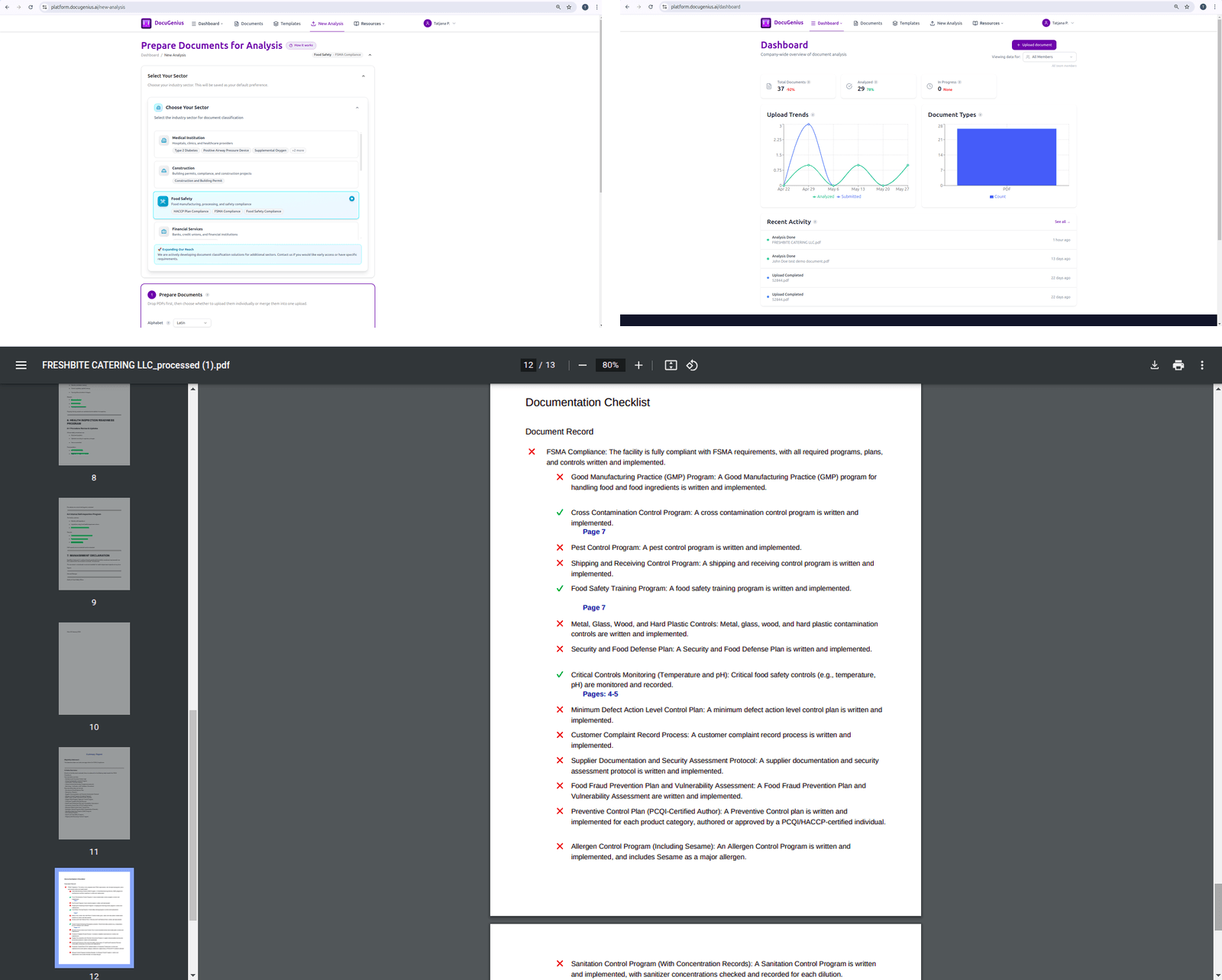
Figure 1: The DocuGenius dashboard. Top left: the guided upload wizard with sector and criteria selection. Top right: the analytics view showing upload trends and processing metrics. Below: a compliance report with color-coded verdicts and extracted evidence.
The dashboard provides a guided upload flow, real-time processing status, interactive compliance reports with color-coded verdicts and inline evidence, a visual rule viewer, role-based team management, and analytics on throughput and cycle time.
The dashboard keeps the technical pipeline out of the reviewer's way. Users upload documents, monitor processing, open the structured report, inspect evidence, and export or share the result from one workflow.
From a product positioning standpoint, the dashboard is what turns the backend into compliance automation software people use. Reviewers experience it as a PDF compliance checker, an AI document review dashboard, an evidence review tool, and a compliance reporting system, not as a collection of LLM prompts and AWS services.
Production Results
In production, the metrics that matter are end-to-end review time, how often extracted evidence matches manual review, how much duplicate work is avoided, and how much manual review time is reduced. These matter more than a single headline benchmark, because performance depends on document length, scan quality, and rule-set complexity. The goal is a predictable operating model, not a one-off demo number.
The platform supports a range of document-heavy verticals today, with custom rule sets added at any time via DMN upload:
- Healthcare: medical eligibility and necessity reviews
- Food safety: supplier and safety-record compliance reviews
- Financial services: loan and identity document review
- Logistics: driver qualification files
- Construction and supplier compliance: certifications and safety documentation
- Custom rule sets via DMN upload: for any compliance domain a team needs to onboard
Operational Trade-Offs Worth Naming
The most important cost-control decision was avoiding unnecessary LLM work. The most important usability decision was making evidence visible to the reviewer. The platform is not designed to hide AI behind a final answer. It is designed to help reviewers move faster while preserving traceability. Individually these are small choices. Together, they are the difference between a demo and a production platform.
Frequently asked questions
How does reuse reduce LLM costs in document compliance?
The platform identifies when prior work can be reused safely. When a document review has already been completed under the same business conditions, DocuGenius can return the existing structured result instead of repeating the AI workflow.
What does an AI compliance dashboard need to be useful?
A guided upload flow, real-time status, color-coded verdicts, inline evidence highlights, visual rule inspection, role-based access for admins and members, and analytics on cycle time and throughput. The dashboard is where the workflow actually lives for compliance teams, not the model.
How long does an AI document compliance review take in production?
Processing time depends on document length, scan quality, rule-set complexity, and the number of evidence checks required. In practice, the goal is to move review from manual minutes per file to an automated workflow that returns results fast enough for operations teams to use in-line.
Acknowledgement
This work was shaped by the engineering effort behind DocuGenius, built by the team at ITQuarks, whose product thinking, implementation, and delivery discipline were instrumental in bringing the platform to life.
Suggested CTA
If you're scoping the unit economics of an AI document review platform, such as cost per file, cache strategy, model routing, and dashboard design, we're happy to compare notes against your workflow. Talk to the DocuGenius team.
What's Next
In Part 6, we close the series with the most important lessons from shipping DocuGenius, what we'd do earlier if we built it again, and final takeaways for teams building AI compliance automation.
Read Part 6: Lessons Learned, What's Next & Final Takeaways, now live. We're also sharing the series one part at a time on LinkedIn, so follow DocuGenius there or bookmark the blog.
