Black Box vs. Audit Trail: Why “The AI Extracted It” Isn’t Enough for a Regulated Claim

Sofija Mamuchevski
Product & Growth Lead | AI Products | Demos, Outreach, Partnerships
Sofija Mamuchevski is Product & Growth Lead at DocuGenius, where she helps organizations modernize complex document workflows through automation, operational standardization, and compliance-focused processes. With more than 10 years of experience across software development, product management, and Agile delivery, she writes about document automation, operational efficiency, product strategy, and workflow transformation in regulated and document-heavy industries.
Reading time
10 min read
Published
August 13, 2026
Extraction returns a value and a confidence score. A regulated claim needs a result that can be reconstructed and defended through editable rules and a full audit trail.
Insurance paperwork drops into the workflow. Another day, another document, but this time it's a policy file that needs review.
Systems today can snag the claimant's name, snag the incident date, snag the policy number, and grab the invoice total. Every field lands clean. The model calls it high confidence. The document gets stamped as processed, ready for what's next.
So-claim ready to advance?
Not always.
With a regulated claim, extraction is only the start. This is why digital claims still rely on manual document workflows, even when every file has already been digitized. Extraction does not answer the bigger questions. Here’s where the real work begins: Does the file contain every required document? Do these values line up with the rest of the materials? Is the evidence strong enough to satisfy the policy or compliance rules? Which rule made the call? What happens when information is incomplete or missing? And six months down the road, could your team show exactly why this claim progressed, stalled, or ended up with a human reviewer?
Saying, "The AI extracted it," only covers what the system found. It says nothing about why the workflow took a certain action.
A confident extraction does not equal a compliant claim
Document extraction saves hours. It kicks manual data entry to the curb. PDFs, scans, forms, emails, and photos turn into structured data that downstream systems can actually use.
But yanking a value out of a document isn’t the same as confirming it matters.
Maybe a model reads an invoice total: $8,450. Helpful, sure. But does that invoice even belong to the right claimant? Is the service date inside the coverage window? Does the number match the approved estimate? Is the required sign-off there? Does the document meet the client’s latest rules? Does that difference require an exception? Should the workflow keep moving forward automatically, or stop for human review?
You can get a correct value and still wind up with a claim that’s incomplete, inconsistent, or just plain non-compliant.
Too many treat confidence scores like a decision. Confidence only tells you one thing: how sure the model feels about what it read. Compliance rules answer something else entirely: does the evidence meet the conditions required to keep the workflow moving? Two separate questions.
When an auditor, regulator, manager, or litigator wants to know why a claim got paid, denied, or escalated, "the model was 94% confident" won’t cut it. They’re after the evidence, the rule applied, the rule’s outcome, and who or what took action.
Most tools quit before the real work starts
Document-intelligence tools have gotten sharp at reading files. Modern platforms can classify, identify fields, summarize, and cough up structured output from formats that would have taken manual labor just a few years back. That’s real progress.
Still, too many workflows hit the brakes after three steps: pull the value, report a confidence score, send the result downstream. All the real operational headaches remain. Someone still has to check if the extracted info is complete, if it’s valid, if it lines up with everything else in the claim. Someone still has to untangle the business rules. Someone must spot the exceptions. And someone has to explain it all when the outcome gets challenged later.
The real black box isn’t the extracted text. What’s hidden is how that information turned into a business outcome. For claims and compliance teams, that’s the battleground.
Regulated claims demand two layers beyond simple extraction
1. Deterministic, editable rules
Claims run on rules. Sometimes buried in policy docs, sometimes in client instructions, scattered across compliance manuals, spreadsheets, decision trees, checklists, or internal guides. Sometimes, they’re nowhere at all-just sitting in the heads of people who know the process inside and out.
And that’s a problem. Two reviewers read the same rule but reach different outcomes. A rule changes-half the checklists stay outdated. New staff take ages to learn the quirks. Compliance knowledge pools in just a few experienced hands.
No AI compliance engine should hide this logic in a prompt or toss it all to a probabilistic model. Rules should be spelled out-clearly.
Decision Model and Notation (DMN) stands as the Object Management Group’s standard for business rules and decisions-business users, analysts, and technical teams can all read it. DMN leans on explicit decision tables and tight rule definitions, not vague business logic. With DocuGenius, the customer’s validation logic lives as editable rules, owned by operations or compliance.
Here’s what really matters: identical validated inputs and the same rule version must give you the same result. Not a probability. Not a new guess depending on who opened the file. A repeatable outcome-ready for review, testing, and change if the business rules shift.
The AI reads evidence. The rules decide what that evidence means for your workflow.
2. A full audit trail
Audit trails need more than a timestamp showing automation ran. Audit-ready claims files allow you to rebuild the sequence from start to finish:
- which document entered the workflow
- arrival time and entry channel
- how the document was classified
- all extracted values
- where each value originated
- which rule set and version ran
- which checks passed or failed
- what was missing or didn’t match
- why the case continued or stopped
- whether a human reviewed an exception
- whether the outcome was accepted, corrected, or overridden
- what information passed to the next system
This is what makes automation defensible.
NIST’s voluntary AI Risk Management Framework calls out accountability, transparency, explainability, and interpretability as hallmarks of trustworthy AI. The framework lays out that trustworthy AI systems must be accountable and transparent, explainable and interpretable. Its guidance says to keep histories and audit logs, document human oversight, and record overrides, exceptions, and escalations.
No one expects every insurer to adopt a single architecture. But explainable AI in insurance claims requires more than a dashboard with model explanations. Organizations need process evidence. Who was responsible? What rule applied? What did the system do? Where did a person step in? Can you reproduce the result?
Audit readiness has become a buying requirement
Claims leaders are under the gun for cycle times. J.D. Power’s 2025 U.S. Property Claims Satisfaction Study found the average homeowners claim now drags on a while. The study puts it bluntly: average claim cycle time from filing to completed repairs is now 32.4 days, and from first notice of loss to final payment is more than 44 days-the longest since 2008. Satisfaction tanks if repairs stretch beyond a month, compared to claims that wrap up inside ten days.
The damage isn’t limited to one slow claim. Accenture ran the numbers. They found up to $170 billion in insurance premiums at risk over five years from poor claims experiences, with $160 billion more in underwriting inefficiencies. The report drew on feedback from over 6,700 policyholders in 25 countries, more than 120 claims execs, and 900-plus U.S. underwriters.
Everyone sees the case for automation. But speed without control is a trap. Automate a shaky process and you just crank out inconsistent results faster. Let a bad extraction slip through and you save a few minutes at intake, only to lose hours to rework, escalations, complaints, or audit headaches.
Audit readiness is what lets teams automate and still keep control. Operations gets the speed. Compliance gets the supporting evidence. Reviewers get a clear exception, not another mystery file to investigate from scratch.
What audit-ready claims automation actually delivers
DocuGenius workflows unfold in four stages: Ingest, Validate, Structure, Route. The difference? Every step creates a record-preserving evidence, not just producing an output.
Ingest
The system receives and classifies the incoming document. Seems simple, but this is where traceability begins. The workflow records what came in, when, from where, which case it’s linked to, how it was classified, and whether it’s a new submission, a correction, or a duplicate. Just dropping files into a queue misses the point. The process should start with a record that allows the entire workflow to be reconstructed.
Validate
Rules come into play, tailored for each claim. Depending on the workflow, checks might cover required documents, mandatory fields, signatures, valid dates, policy conditions, amount limits, cross-document consistency, client-specific instructions, and coverage or evidence standards.
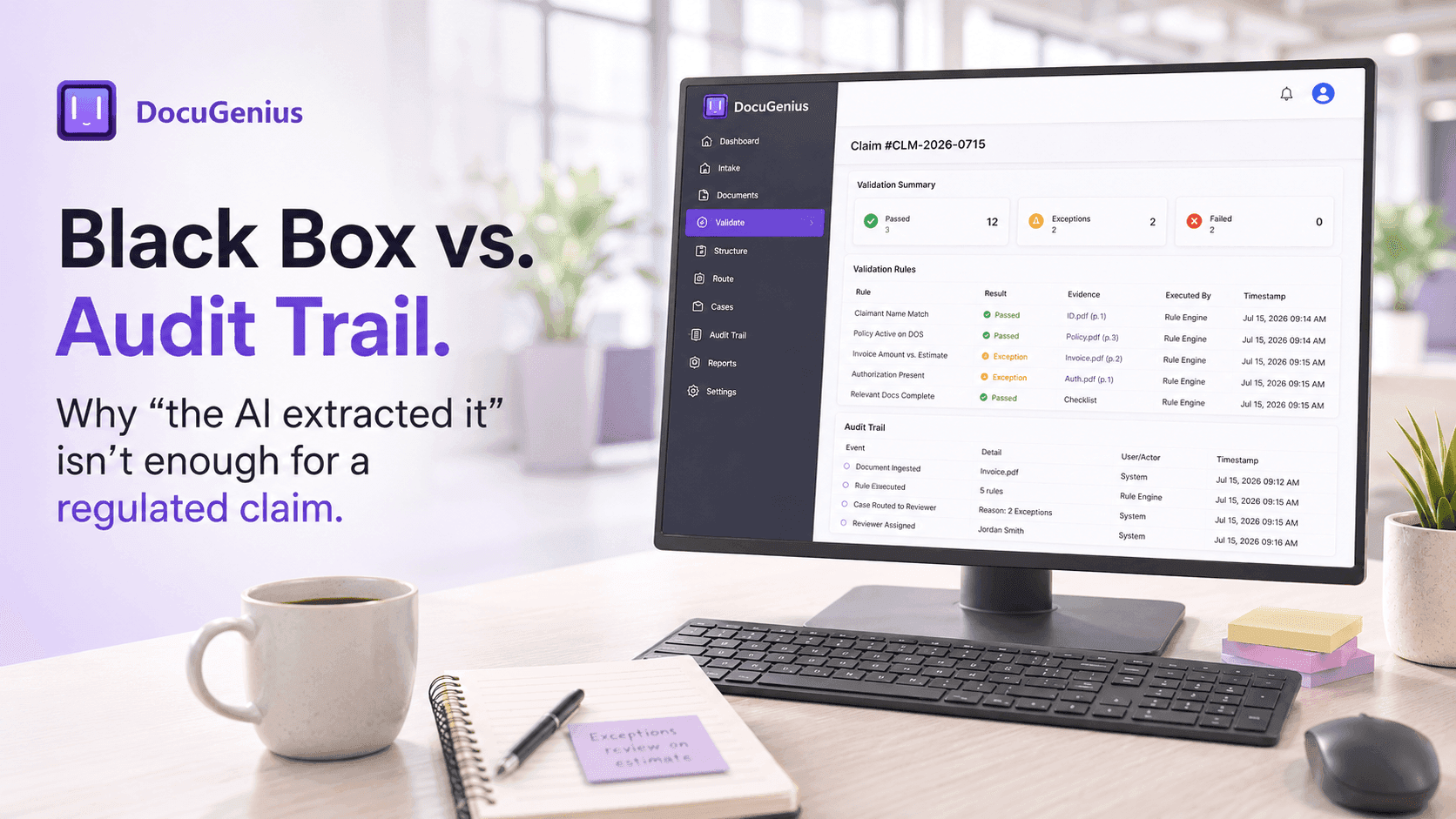
A black-box system just says: Document approved. Audit-ready automation shows the exact rule that ran, its version, the input evidence, the pass/fail/exception result, and the reason. Here’s where extraction becomes compliance.
Structure
Verified data is turned into usable information for the claims platform, case management, or downstream workflows-but always with a clear line back to the source. Reviewers can trace each structured value back to the original document and see how it was normalized. Standardized a date? The original gets logged. Corrected or mapped a name, amount, or ID? That transformation is documented. Data without source evidence is easier to process. Data with a source is easier to trust.
Route
Clean cases move through the workflow as usual. Exceptions get flagged and routed to the right person, complete with context. The system shows why the exception was triggered, which rule flagged it, what evidence needs review, who received the case, what action the reviewer took, and whether the reviewer accepted or overrode the AI’s result. No more reopening five files to find the snag. The system lays out the issue. The person makes the big decision.
Let’s walk through an example
Take a motor claim: repair estimate, final invoice, photos, policy record, signed authorization form-all included.
An extraction tool can spot the claimant, vehicle info, dates, estimate, invoice total. That’s helpful.
An audit-ready workflow goes further. It checks that claimant and vehicle IDs match across every document. It verifies the authorization is signed, confirms the invoice matches-or flags that the final amount overshoots the permitted difference. It logs the rule that caught the exception. Then it routes the case to the right handler, showing the exact discrepancy.
No need for the handler to piece the problem together from scratch. The system’s already done the prep, with evidence attached. Now the handler can decide: does this exception need an override, more investigation, or a straight denial?
Audit-ready claims automation doesn’t only process faster-it leaves a clear trail. Every step is visible. Every exception is explained. Every action can be traced from start to finish. That’s what separates a compliant workflow from just another black box. The real question: does your process make it that easy to show your work when it matters most?
Sources
-
J.D. Power — 2025 U.S. Property Claims Satisfaction Study
Used for the average claims cycle of 32.4 days, the period of more than 44 days from first notice of loss to final payment, and the 167-point satisfaction difference between faster and slower repairs.
Read the J.D. Power study -
Accenture — Poor Claims Experiences Could Put Up to $170 Billion of Global Insurance Premiums at Risk
Used for Accenture’s modeled premiums-at-risk estimate and its findings on customer dissatisfaction, settlement speed and insurer switching.
Read the Accenture research -
McKinsey & Company — Claims 2030: A Talent Strategy for the Future of Insurance Claims
Used for McKinsey’s projection that more than half of current claims activities could be replaced by automation by 2030, while human handlers remain central to complex claims and exceptions.
Read the McKinsey analysis -
Object Management Group — Decision Model and Notation
Used for the definition of DMN as a standard for specifying business decisions and business rules in a form that can be understood by business and technical teams.
Read about the DMN standard -
National Institute of Standards and Technology — AI Risk Management Framework
Used for the governance principles covering accountability, transparency, explainability, documentation, human oversight, audit logs, exceptions and overrides.
Read the NIST AI Risk Management Framework -
National Institute of Standards and Technology — AI RMF Playbook
Used for practical guidance on maintaining audit records, documenting human oversight and tracking exceptions, escalations and overrides in AI-supported workflows.
Read the NIST AI RMF Playbook

Sofija Mamuchevski
Product & Growth Lead | AI Products | Demos, Outreach, Partnerships
Sofija Mamuchevski is Product & Growth Lead at DocuGenius, where she helps organizations modernize complex document workflows through automation, operational standardization, and compliance-focused processes. With more than 10 years of experience across software development, product management, and Agile delivery, she writes about document automation, operational efficiency, product strategy, and workflow transformation in regulated and document-heavy industries.