From PDF to Decision: How DocuGenius Turns Compliance Documents into Automated Rules

Tamara Kostova
ML Engineer
Tamara Kostova is an ML Engineer at ITQuarks, where she works on Docugenius, an AI-powered document processing platform. Her work focuses on developing machine learning and large language model solutions that help extract, structure, and interpret information from complex documents.
Reading time
6 min read
Published
April 23, 2026
Updated
June 2, 2026
Manual document review shouldn't be a full-time job. See how DocuGenius extracts compliance rules from your PDFs and automates the checking - consistently, every time.
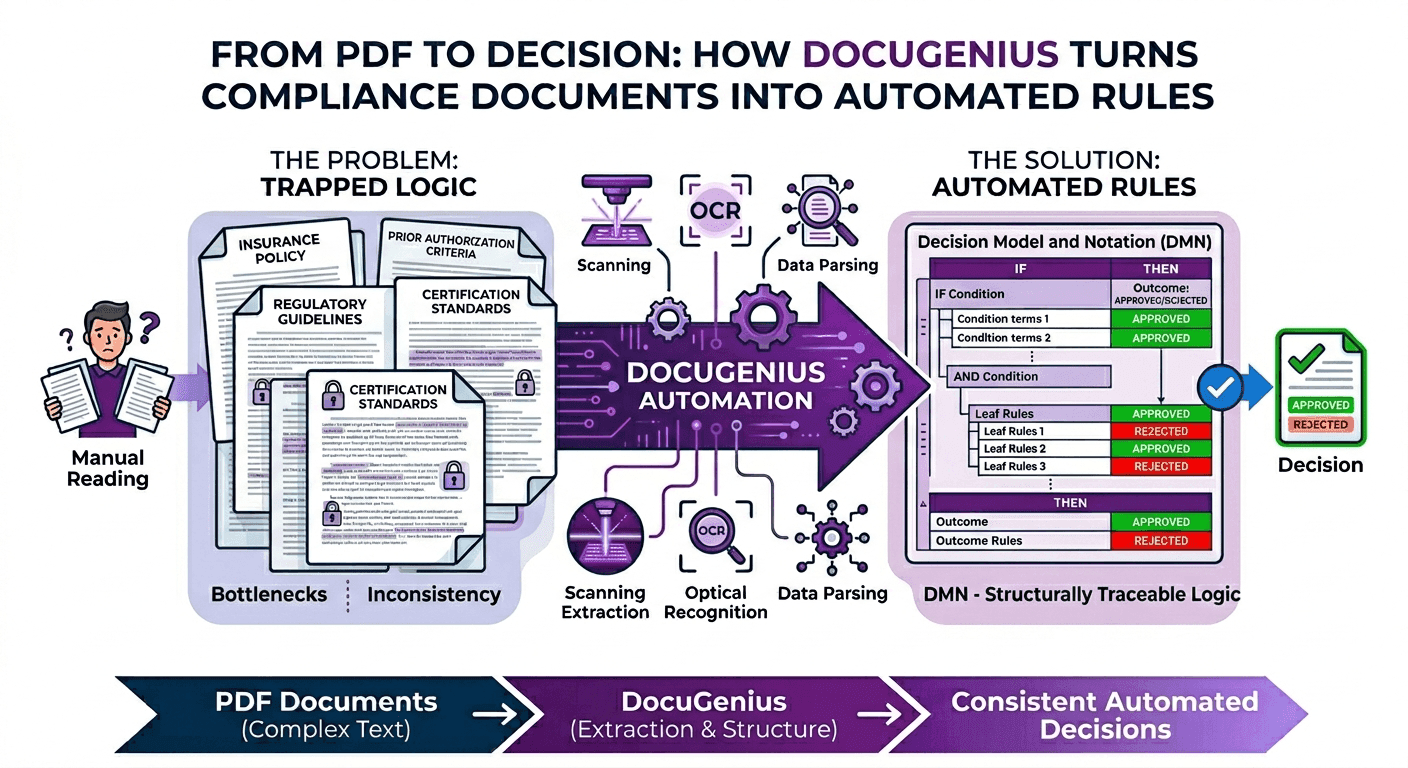
Compliance rules live in documents. Insurance eligibility policies. Medical prior authorization criteria. Food safety certification standards. Regulatory guidelines.
These documents define exactly what must be true before a claim is approved, a shipment clears customs, or a patient qualifies for a procedure. They are carefully written, regularly updated, and critically important.
They are also, almost always, PDFs.
And that is the problem.
The Logic Is There. It Just Can't Be Used.
When compliance rules exist only as text in a document, every decision that depends on them requires a human to read and interpret that document. That human might be a claims handler, a compliance officer, a clinical reviewer, or a regulatory specialist.
They are not reading the document because they enjoy it. They are reading it because the logic is trapped inside it, and there is no other way to apply it.
This creates the familiar bottleneck: reviews that take hours, inconsistencies between reviewers, backlogs that grow faster than teams can clear them, and decisions that are hard to explain or audit after the fact.
The goal of DocuGenius is to free that logic from the document and make it work for you.
What DMN Is, and Why It Matters
DMN (Decision Model and Notation) is an open standard for representing decision logic in a structured, executable format. Think of it as a blueprint for a decision: every condition is explicit, every rule is named, and every outcome is traceable.
A DMN model is not a summary of a document. It is the decision logic itself, expressed in a form that can be run, tested, and audited. It tells a system, or a reviewer, exactly which criteria apply, what they require, and whether a given document or case satisfies them.
The value of DMN is auditability. When a claim is approved or rejected, you can point to the exact rule that determined the outcome. When a policy changes, you update the model and the change applies consistently from that moment forward. No interpretation, no variation between reviewers.
From Document to Decision in Minutes
Building a DMN model used to mean weeks of work: domain experts reading policy documents, analysts translating requirements, developers encoding logic, testing, revision. For teams that review hundreds of document types or update their criteria quarterly, that cycle was a constant operational cost.
DocuGenius automates it.
You upload your compliance document, a PDF of any length, whether a clean digital export or a scanned paper document, and DocuGenius reads it. The platform extracts the compliance criteria from the text, understands their structure and relationships, and produces a complete DMN model that captures the decision logic from the document.
The result is ready to use. Criteria are organized into a clear hierarchy. Parent conditions group related rules. Leaf rules represent the specific, checkable requirements. The logic is no longer buried in paragraphs. Instead, it is structured, named, and operational.
When a Case Arrives in Multiple Files
Once your compliance project is set up and your rules are ready, the documents you need to check against them rarely arrive as a single file.
A patient's case might include a referral letter, a diagnosis report, and lab results which are usually separate PDFs. An insurance applicant might submit an ID document, a medical history form, and a supporting certificate. A logistics shipment might have an invoice, a packing list, and an origin certificate.
DocuGenius lets you upload all of those files together and merge them into one before running the compliance check. The platform combines them in the order you specify and processes the result as a single submission - one analysis, one output, one result against your criteria.
This means your team does not need to run a separate check for each document and manually piece together the outcome. You bring the full case as it arrived, and DocuGenius evaluates it as a whole.
Consistency You Can Audit
One of the most significant costs of manual document review is invisible: inconsistency.
Two reviewers reading the same policy document will not always reach the same conclusion. The same reviewer on two different days may weigh a borderline case differently. These variations accumulate into compliance risk, customer complaints, and audit exposure.
When your decision logic lives in a DMN model derived directly from the source document, that variation disappears. Every case is evaluated against the same rules, in the same way, every time. When the document is updated, the model is updated, and not some reviewers' mental models and not others'.
The audit trail is automatic. Every decision points back to a rule. Every rule points back to the location in the document it came from.
Who This Is For
DocuGenius is for anyone who reviews documents against a set of rules and does it often enough that the process has become a burden.
If your team spends significant time reading the same types of documents, checking them against criteria that live in a policy, a standard, or an internal guideline, and reaching decisions that should be consistent but often are not, then this is for you!
It does not matter what industry you are in. If you have a compliance document that defines what must be true, and a stream of other documents that need to be checked against it, DocuGenius can automate that review. Upload your criteria document to create a project, and from that point forward, the checking is handled for you.
For teams in insurance, healthcare, legal, transportation, and food safety, we have prebuilt project templates ready to go. But you are not limited to those. If your use case is different, you can upload your own document and build exactly what you need from scratch.
The teams that benefit most are those that have been doing this manually for a long time, not because they chose to, but because there was no better option. There is now.
The Bottom Line
Compliance documents are not the problem. The problem is that the logic inside them is not usable until someone reads it.
DocuGenius reads it for you. It extracts the criteria, structures the rules, and produces a decision model that your team can apply consistently, no matter if you are reviewing ten documents a day or ten thousand.
The compliance logic was already in your documents. DocuGenius just makes it work.
See it in action with your own documents. Try DocuGenius free or reach out at support@docugenius.ai

Tamara Kostova
ML Engineer
Tamara Kostova is an ML Engineer at ITQuarks, where she works on Docugenius, an AI-powered document processing platform. Her work focuses on developing machine learning and large language model solutions that help extract, structure, and interpret information from complex documents.