The AI Claims Employee: Operational Advantage in Insurance | DocuGenius

Tanja Spasevska
Operations Manager | Growth
Tanja Spasevska is leading day to day product and operation activities in ITQuarks. She has deep understanding in compliance and R&D projects operations.
Reading time
12 min read
Published
April 20, 2026
Updated
June 2, 2026
Insurance markets are posting record growth — but claims operations haven't kept pace. The AI Claims Employee is a digital workforce layer that cuts intake from weeks to same-day, frees 40-60% of team capacity, and maintains full regulatory compliance. Backed by real market data from the UK.
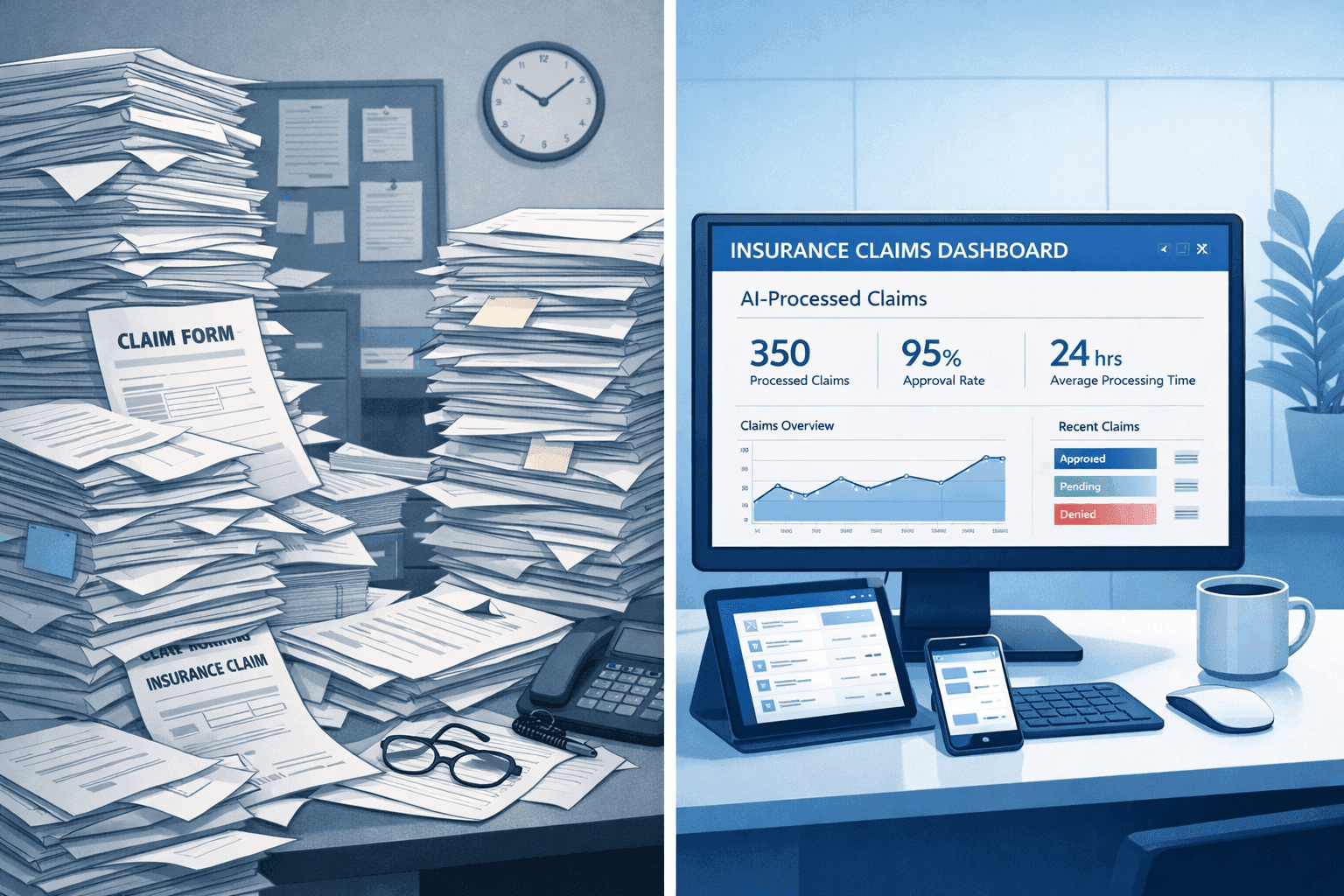
AI in Insurance Claims: How to Reduce Manual Work and Speed Up Processing
Meet Your Claims Department
James has been a senior claims handler for eleven years. He can spot a suspect invoice at a glance, negotiate with loss adjusters in his sleep, and explain policy exclusions to upset customers with the patience of a saint. He is very good at his job.
Right now, James is copying a diagnosis code from a scanned hospital letter into a spreadsheet. He has done this fourteen times today. He will do it another twenty before he leaves.
Alice joined the compliance team eight months ago with a master's in regulatory affairs. She was hired to strengthen the company's FCA Consumer Duty response — audit trail design, outcomes monitoring, claims handling standards. Important, strategic work.
This morning, Alice is checking whether a stack of dental claim forms have the correct policyholder reference numbers attached. Manually. One by one.
Tom runs the claims operations team — twelve people, all capable, all busy. Last quarter, the company onboarded 40,000 new corporate health members. Tom's team didn't grow by a single headcount. He spends most of his management time juggling backlogs, apologising for turnaround times, and explaining to the board why cost-per-claim keeps rising despite everyone working harder than ever.
James, Alice, and Tom are not underperforming. They are trapped in a process that wastes their expertise on work a machine should be doing.
This is the most expensive administrative problem in insurance. And it's getting worse.
The Bottleneck No One Budgeted For
Insurance markets worldwide are posting record growth. Claims operations are not keeping pace.
Documents arrive as PDFs, scans, blurry mobile photos, and email attachments. Compliance checks depend on whoever reviews the file that day. Data is re-entered multiple times across disconnected systems. A single health claim routinely passes through three to four people before it is structured and ready to settle.
The result: growing backlogs, rising cost per claim, inconsistent quality, and increasing regulatory scrutiny.
The insurers that solve this will define the next decade. The rest will lose ground quarter by quarter.
The Growth Equation That Doesn't Add Up
The maths confronting insurance COOs globally is straightforward — and unforgiving.
When a carrier adds hundreds of thousands of new customers in a single half-year — like Tom's company did — claims capacity must scale in lockstep. If it doesn't, those customers file a claim, wait three weeks, receive a "please resubmit" email — and they are gone at renewal.
When premium growth runs at 20%+ year-on-year, you cannot hire 20% more claims staff annually. Recruitment cycles are measured in months. Training takes longer. Tom knows this: he requested four new hires in January. HR shortlisted two candidates by April. The backlog didn't wait.
When medical inflation runs above 12%, claims costs increase regardless of what you do operationally. The only remaining lever is processing efficiency.
Every day saved in claims processing is a customer retained, a cost avoided, and a regulator satisfied.
What an AI Claims Employee Actually Does
This is not a chatbot, a dashboard, or another tool layered on top of an already crowded tech stack.
An AI Claims Employee is a digital workforce layer between incoming documents and core systems. It does not replace James, Alice, or Tom — it removes the manual work they should never have been doing.
Here is what changes:
1. Ingest. Every document James used to open, read, and classify — PDFs, scans, photos, portal uploads, email attachments — is read and understood automatically. Regardless of format, quality, or source. No human intervention required.
2. Validate. The compliance checks Alice has been doing by hand — policyholder references, document completeness, eligibility rules — happen automatically against deterministic, auditable rules. Not AI guessing. Real rule logic with an evidence trail for every decision. The FCA can trace exactly why each claim was approved, flagged, or routed.
3. Structure. The data entry that consumed most of James's day — copying diagnosis codes, treatment dates, provider details — is extracted into clean, system-ready formats. JSON, CSV, or direct API push to claims platforms, CRMs, or data warehouses. No retyping. No transcription errors. No version confusion.
4. Route. Clean claims flow straight through to core systems. Only genuinely complex or flagged cases reach human reviewers — the cases that actually deserve James's eleven years of expertise.
The outcome:
James spends his day on complex adjudication, fraud patterns, and the cases that need a human eye — not copying diagnosis codes.
Alice designs compliance frameworks, monitors outcomes, and strengthens audit trails — not checking reference numbers on dental forms.
Tom's team handles 2-3x the claim volume without new headcount. The backlog shrinks. Turnaround times drop. The board stops asking uncomfortable questions.
Market Evidence: The UK Picture
The shift from manual to AI-assisted claims processing is not theoretical. The UK market illustrates the pressure — and the opportunity — clearly.
The UK private medical insurance market reached £7.02 billion in premiums in 2024, covering 8.43 million people — the highest market penetration since 2008. The driver is well-documented: NHS waiting lists hit 7.42 million in March 2025, pushing employers and individuals toward private cover at unprecedented rates.
The operational impact is immediate. Insurance-funded hospital admissions rose 6% year-on-year to 664,000 in 2024. Medical inflation is running at 12.6% — three points above the European average. The Big Four carriers (Bupa, Aviva, AXA Health, Vitality) collectively control 85-95% of the PMI market, and every one of them faces the same constraint: claims processing infrastructure built for a smaller, slower era.
The numbers are specific: Bupa added 400,000 UK customers in H1 2024 alone. AXA Health grew premiums 12.1%. Vitality is expanding aggressively in corporate wellness — high volume, tight SLAs. Every one of those carriers has people like James, Alice, and Tom — and every one of them is asking the same question Tom is asking: how do we scale without breaking?
Meanwhile, the average UK property damage claim now takes 353 days to settle — up from 287 in 2019. Health claims move faster, but the volume trajectory is relentless. And the FCA's Consumer Duty has enforcement teeth: claims must be handled promptly, fairly, and transparently, with defensible audit trails.
The pattern repeats globally. Whether the market is mature like the UK or high-growth like Southeast Europe and emerging markets, the dynamic is identical:
- Premium growth outpaces operational capacity
- Manual claims processing creates a hard ceiling on scalability
- Regulatory expectations are rising simultaneously
- The carriers that automate intelligently capture disproportionate market share
The Industry Has Already Moved
If AI in insurance claims still sounds experimental, the adoption data says otherwise:
- 80% of insurers are deploying AI in at least one core function (2026)
- Full AI adoption jumped from 8% to 34% between 2024 and 2025
- Claims processing leads at 64% adoption — the highest of any insurance function
- AI-enabled carriers report 75% faster claim resolution and 30-40% lower cost per claim
- The AI claims processing market is growing at 28.4% CAGR through 2029
Modern agentic architectures — where specialised AI agents collaborate on multi-step workflows — handle the full claims intake pipeline. Classification, extraction, cross-referencing, validation, and routing operate in an orchestrated pipeline where each agent handles what it does best, using the optimal model for each subtask.
The question is no longer whether to automate claims. It is whether you automate fast enough to capture growth — or slowly enough that competitors capture it first.
Compliance Without Compromise
This is where Alice's work becomes critical — and where most AI solutions introduce risk instead of reducing it.
Regulators across jurisdictions — from the UK's FCA Consumer Duty to Solvency II frameworks across Europe — are tightening expectations around claims handling. Processing must be prompt, fair, and transparent. Every decision requires a defensible audit trail. Consistency must be measurable.
Generic AI tools create a dangerous paradox: speed without explainability. In a regulated industry, unexplainable speed is a liability.
The architecture that works separates AI from decision-making:
- AI handles unstructured work — reading documents, extracting fields from variable-quality inputs, classifying claim types across formats and languages
- Deterministic rule engines handle auditable work — validation, eligibility, compliance checks, routing decisions
This is typically implemented using DMN (Decision Model and Notation) — the same standard used in enterprise process automation globally. Every decision is explainable. Every action has an evidence trail. Every rule change is logged, versioned, and testable.
This isn't "trust the AI." It's a compliance architecture that Alice can defend in front of the FCA — because she designed the rules, not a developer three teams away.
No-Code Rules: Business Teams Own the Logic
Insurance compliance evolves constantly. Policy terms change. Products launch. Regulations update quarterly. Waiting for a development sprint to modify a compliance rule — while processing thousands of claims against outdated logic — is an operational risk most insurers can no longer afford.
No-code rule management changes the operating model:
- Compliance officers and claims managers edit rules directly through visual editors — no code, no developer dependencies
- Changes deploy in hours, not release cycles
- Rules are testable — validate against sample data before anything goes live
- Rules are reusable — build a validation template for one product line, deploy across others instantly
Alice updates a rule on Tuesday morning. By Tuesday afternoon, every claim processed reflects the change. No tickets. No sprints. No waiting.
Operational Impact: The Numbers
Processing Efficiency
| Metric | Manual Process | With AI Claims Employee |
|---|---|---|
| Document intake to structured data | 30-60 minutes | 2-5 minutes |
| Compliance validation | Manual, variable quality | Automated, deterministic, auditable |
| Claims requiring human review | 100% | ~15-20% (exceptions only) |
| Turnaround to customer | 3-10 business days | Same day |
| Audit trail completeness | Partial, reconstructed after the fact | Complete, automatic, real-time |
Team Capacity
Across deployments, 40-60% of claims team capacity previously consumed by document preparation, validation, and data entry is redirected to higher-value work:
- Complex claims adjudication requiring human judgement
- Customer relationships that drive retention and referrals
- Fraud investigation and pattern detection
- New product development and underwriting support
- Regulatory reporting — proactive, not reactive
The same team handles 2-3x the claim volume. Tom's twelve people do the work that used to require thirty. Not because they work harder — because they finally work on the right things.
The Retention Equation
Claims is the single most important customer experience touchpoint in insurance — the moment a policyholder discovers whether their insurer delivers.
- Fast claims = higher satisfaction = lower churn = greater lifetime value
- Consistent decisions = fewer complaints = stronger regulatory standing
- Transparent processing = trust = referrals and renewals
Every day saved in claims processing converts directly to measurable revenue protection.
What to Evaluate in an AI Claims Solution
Not every automation tool is built for regulated claims environments. The differentiators that matter:
Compliance-first architecture. AI extracts data. Deterministic rules make decisions. This separation is non-negotiable. Look for DMN-standard rule engines, complete audit trails, and outputs that withstand regulatory scrutiny.
No-code rule management. If a compliance rule change requires a developer ticket, the speed advantage of automation is already compromised. Business teams must own the rules directly.
System integration without disruption. The platform should operate alongside existing infrastructure — not replace it. Documents flow in from any source, through AI extraction and rule validation, out as structured compliant data into whatever core systems you run — Guidewire, Salesforce, bespoke platforms, or legacy systems. Integration should be measured in weeks, not quarters.
Multi-LLM optimisation. The best platforms route each subtask — classification, extraction, validation — to the optimal model for that task. This maintains accuracy while keeping costs proportional to value.
Production-ready templates. Starting from zero is unnecessary and risky. Look for pre-built compliance templates from real insurance deployments — validated rule sets, extraction schemas, and routing logic that work on day one and customise in hours.
Proof of Concept: 8 Weeks to Measured Results
No 18-month implementation programme. No seven-figure upfront commitment. No rip-and-replace.
| Phase | Timeline | Scope |
|---|---|---|
| Connect | Weeks 1-2 | Integrate document sources, configure initial extraction and validation rules |
| Deploy | Weeks 3-4 | Run AI claims processing in parallel with existing manual workflow |
| Measure | Weeks 5-6 | Track automation rate, cycle time reduction, and error rate against baseline |
| Decide | Weeks 7-8 | Optimise rules, present measured results, plan full deployment |
8 weeks. Your claims. Your documents. Your rules. Measured outcomes from production data — not projections.
The Convergence Is Now
Every structural force in the industry is pushing in the same direction:
- Record premium growth is flooding claims departments with volume they were not built to handle
- Medical inflation above 12% is increasing claims costs independent of operational performance
- Regulatory pressure on claims speed, fairness, and transparency is intensifying across jurisdictions
- Mature AI technology has moved from pilot programmes to production-scale deployment
- Customer expectations — shaped by digital-first experiences in every other industry — demand same-day resolution
The insurers that adopt intelligent claims automation now are compounding their advantage. Every month of faster processing, higher accuracy, and better customer experience widens the competitive gap.
James, Alice, and Tom exist in every insurance company. The question is whether your James is still copying diagnosis codes — or whether he's already doing the work he was hired for.
The AI Claims Employee is not a future capability. It is operational today — and it is already working for your competitors.
DocuGenius is — compliance-first document intelligence powered by agentic AI and no-code rules. See the AI Claims Employee in action with your own documents.
Ready to see the difference? Reach out at support@docugenius.ai or visit docugenius.ai
Market data: LaingBuisson Health Cover UK Market Report 2025, FCA Consumer Duty publications 2025-2026, Private Healthcare Information Network (PHIN), Insurance Times AI Claims Report 2025/26, Willis Towers Watson Global Medical Trends Survey 2024.

Tanja Spasevska
Operations Manager | Growth
Tanja Spasevska is leading day to day product and operation activities in ITQuarks. She has deep understanding in compliance and R&D projects operations.